MIDI is actually just serial data at 31,250 bps in 8N1 format that is transmitted over a 5-pin DIN cable. This means you can receive MIDI data from your musical instrument using a serial port, or an FTDI cable.
Receiving MIDI data over the FTDI cable doesn’t magically turn your USB serial device into a MIDI device - you need to be running a software bridge or a driver that pretends to be a virtual MIDI device emitting these messages. For this purpose, I shall use the Serial MIDI Converter from SpikenzieLabs.
I’m using Mac OS X 10.6.6 and the latest Java update, so I didn’t need any extra JAR files.
Wiring It Up
The circuit is relatively simple - you need the DIN socket, an opto-isolator, 2 resistors, and optionally a diode. In my case, parts came from a scrap bin, so I used a 330 ohm resistor instead of a 220 ohm for Rb and a 1 K for Rd instead of 280 ohms. For the opto-isolator, element14 had some non-RoHS CNY17-2 on sale, so I just used that.
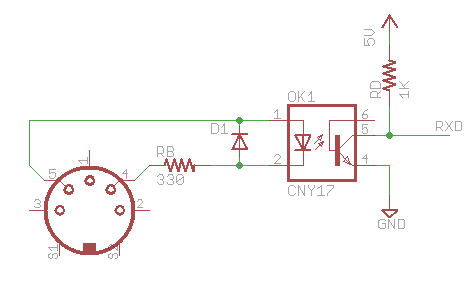
Note that the RXD output is only meant for interfacing with a TTL circuit like an FTDI chip/cable or MAX232 transceiver, not the RS232 serial port directly.
You can find the same circuit diagram (with different values & parts) in the official MIDI Electrical Specification Diagram.
Continue reading "MIDI to USB (Serial) Converter"→
The PCB I made recently was for this project that converts audio from a TOSLINK input to analog stereo.
My new TV has no analog audio outputs - only an optical one (and its speakers suck), and the “home theatre” system (a Sony DVD player with a 5.1 speaker system) accepts only analog stereo. If I bought a home theatre system I would have made sure it has an optical input, or at least “line in” inputs for the 5.1 so that I can use the amp. This little project was designed to bridge the 2 systems (with loss of audio quality).

The circuit is really simple - most of the heavy lifting is done by 2 main ICs - the DIR9001 digital audio receiver and a WM8762 DAC.
Continue reading "Optical to analog audio converter"→
This is my first try designing and fabricating a PCB, so I decided to use iteadstudio.com since they are the cheapest available - US$12 for 10 pieces of the same 5 x 5 cm board. I tried my best to make the design error-free because I didn’t prototype the circuit first (not really a good idea). I’m still waiting for the components to come in, so I can’t tell if there are any problems yet.
Continue reading "iteadstudio PCBs"→
If you want a working filter design fast, Texas Instruments has the document for you. http://focus.ti.com/lit/an/sloa093/sloa093.pdf High pass, low pass, band pass, band reject. Circuits for dual and single supply designs too.
ladyada maintains a wiki page of parts called Partfinder, so I thought I might just use the name because I lack creativity. Hope she doesn’t mind.
I bought a couple of the rotary encoders that SparkFun carries through a local online store here called sgbotic.com for S$4.95 and I was wondering whether there were any other similar alternatives. I did a search on my favourite component distributor, now called element14, and it turns out there is a cheaper alternative! So I thought I’d share it here.
Continue reading "Partfinder: Alternative to SparkFun's Rotary Encoder"→
It’s sad that my family members always buy stuff that lack features I want (or sometimes sane features - I’ll talk more about this in another post hopefully in a few weeks). Obviously if I had a say in it, I would definitely not have picked it. My sister bought a Panasonic Lumix LX-3 some time ago, but unfortunately, it lacked a remote release feature. The previous camera, bought by my dad, was a Sony DSC-T1, and it too, lacked such a feature.
Continue reading "Lumix LX3 (Lacks a) Remote Shutter Release"→
[youtube=http://youtube.com/watch?v=E55h2JCuCWk] Here’s a nice video about how an oscilloscope (or generally a regular) cathode ray tube works.
Correction: The device is actually an iMON Multi-Median (MM), which includes an IR receiver and a remote control. My friend recently passed me a brand new unopened SoundGraph iMON IR receiver device. Here’s how it looks like: As you can see from the box, it supports up till Windows XP. If you’re thinking how the terms “Windows XP” and “brand new unopened” go together, it’s because he’s kept it for 4 years.
Continue reading "Dissecting the SoundGraph iMON MM"→
This was my first time trying to really repair something, and I’m forced to do it. It’s an Akira DVD player that is used as an audio CD player. When I received the unit, I plugged it in and turned it on. Hmmm… nothing happened, so I opened it up to see what’s wrong. Apparently it has bulged capacitors, which is quite a common problem. I guess the main cause was the 100 μF smoothing capacitor that’s placed directly after the rectifier bridge.
Continue reading "Repairing an Akira DVD Player"→
When I got my iPhone, it uses a 4-digit passcode to protect its contents. Unsatisfied with this, I found the iPhone Configuration Utility (iPCU), which was the only way at that time to enable complex passcodes (passwords) on the phone. After creating a profile and uploading it to the phone using the iPCU, my backups were all forced to be encrypted. Encrypted backups are not good for tinkering because you need to decrypt the files before you can edit them, and you need to re-encrypt them for it to be restored to the phone.
Continue reading "iOS Profiles & Encrypted Backups"→
